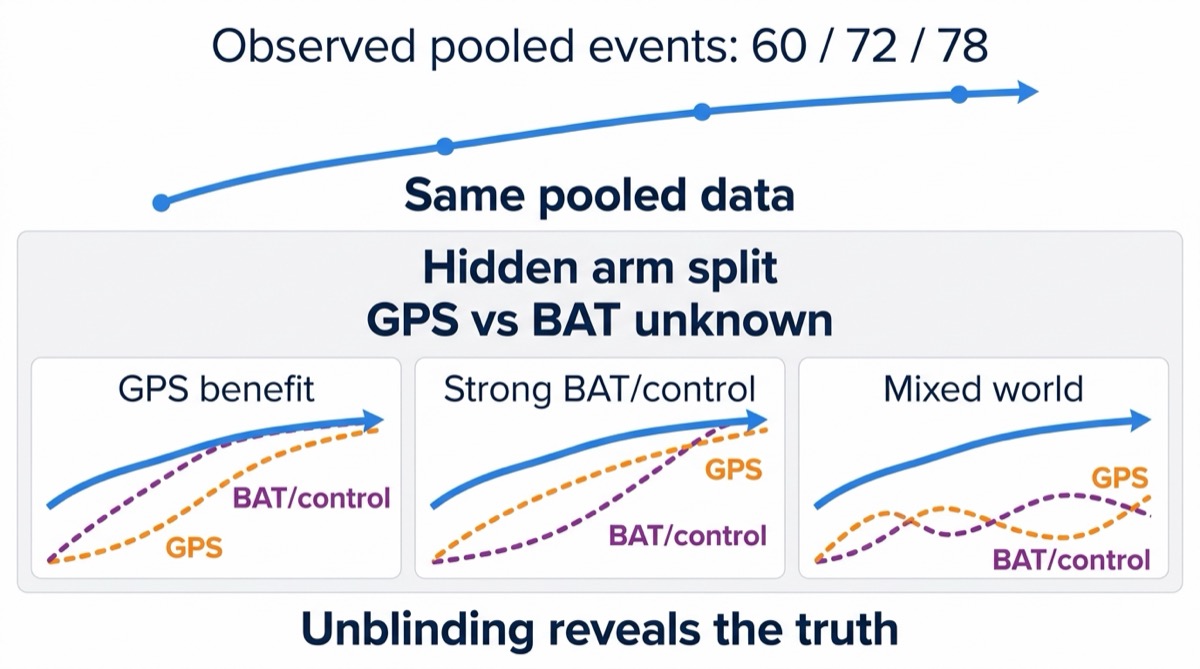
Fact SELLAS reports pooled death counts (60 → 72 → 78) from an ITT trial (NCT04229979) — not which arm each death belongs to. The Aug 11 Q2 update officially said “approaching” 80; interpreting that as 78 or 79 events is an explicit model assumption. No official announcement was found through Sep 18, but that later silence is not treated as an event-count bound because database lock and reporting can lag the event.
What the chart shows: Model overall-survival curves from randomization—not patient-level Kaplan–Meier estimates. Default curves mix favorable/intermediate/adverse prognostic assumptions within each arm; legacy mode uses one homogeneous curve per arm.
Hazard ratio (HR): Pike/O–E descriptive ratio from pooled marginal-arm risk sets. The published primary analysis is a Cox model stratified by CR1 duration, poor-vs-other cytogenetics, CR2/CRp2 and MRD. Poor cytogenetics is not the same category as ELN adverse. Because patient-level analysis factors are unavailable, the app does not reconstruct REGAL stratification or use ELN labels as test strata; HR 0.636 is the design alternative, not the formal win rule (Jamy & Cicic 2025).
Monte Carlo P(significant): Sample documented input uncertainty → weight draws by an approximate Poisson event-increment likelihood → score the final analysis at 80 deaths. Endpoint reach by a selected date is reported separately. Percentile ribbons are model intervals, not observed confidence intervals.
Anchor-constrained inversion: Mandatory constraint = reproduce event anchors (60/72/78). GPS cure fraction is the swept structural assumption (cw35/cw42/cw50 + inversion MC); least-squares solver derives implied BAT median/tail and GPS uncured mOS. HR and mOS are outputs — still non-identifiable along the GPS-cure ↔ BAT-heterogeneity ridge (critique thread).
Show math
Expected observed deaths @ T = Σenrollment Narm · wenroll · ∫ C(u)·[−dS(u)], where C(u)=(1−LTFU36)u/36
HR ≈ (OGPS/EGPS) ÷ (OBAT/EBAT) · Z = (Σ w(O−E)) / √(Σ w²V), using pooled marginal-arm risk sets
MC weight ∝ Pois(60|λ46) · Pois(12|λ58−λ46) · Pois(6|λ63−λ58) · P(Δ≤1 through optional m66 wording interpretation)
Binding interim: weight × P(continue) · win = conditional power with ρ = √(60/80)
Full derivation: click Methodology. Tags: fact primary source · model simulation · assumption undisclosed slider.
|
Limitationscaveats — Blinded pooled death counts fix the timeline but not the arm split (GPS vs BAT): many parameter sets fit 60/72/78, including HR ≈ 1 null-effect worlds. The Sep 18 no-official-announcement status is weaker than an announced count and can be affected by reporting lag. HR gauges and curves are model outputs from an unstratified marginal-arm score, not the SAP stratified Cox. Calendar months assume trial month 0 = 8 Feb 2021.
model family
ELN-explicit prognostic sensitivity
assumption ranges REGAL has not disclosed its ELN mix or arm-level ELN outcomes. ELN groups are used only to build each arm's marginal survival curve; they are not primary-analysis strata, and ELN adverse is not interchangeable with poor cytogenetics. Published 95% CIs are shown only where a source reported them; simulation ribbons are 90% model intervals.
ELN values and uncertainty inputs
Preset ranges: mix 15–32 / 42–62 / 16–35%; BAT subgroup mOS 16–25 / 13.5–20.2 / 9–16m; subgroup 3y OS 25–42 / 14–25 / 1–9%. All are assumption ranges.
Significance-test weightingUnweighted log-rank active
The published design specifies a stratified Cox model, but the required patient-level factors are unavailable. The default is therefore an unstratified marginal-arm log-rank score; FH(0,1) is an exploratory sensitivity that gives later deaths more influence and can favor delayed separation.
Drag to update both survival curves in real time. Uncertainty bands turn on automatically. Some conservative ELN points do not fit all blinded event anchors and are reported as misses rather than forced to fit; this is a one-dimensional scenario tour, not a posterior percentile.
Current state: ELN-explicit · durable responders only. Projected final HR updates with the active model.
What this tab computes. Given arm-level survival curves you set, it (1) checks them against the announced blinded event counts, (2) estimates the hazard ratio and its statistical significance, and (3) runs a Bayesian Monte-Carlo posterior over the final HR.
1 · Survival & events
Default ELN mode builds favorable/intermediate/adverse BAT curves from subgroup mOS and 3-year OS assumptions, then allocates GPS durable responders within each risk group. Those subgroup curves are mixed first to form marginal BAT and GPS curves; ELN labels do not define the efficacy-test strata. Non-durable GPS patients follow their ELN baseline unless leaky benefit is selected. Legacy mode retains the homogeneous Weibull/mixture-cure family. Expected deaths use 63 patients per arm (126 randomized).
2 · Hazard ratio & significance
HR is descriptive via the Pike/O–E estimator. The implemented verdict uses the expected unstratified marginal-arm log-rank scoreZ = (Σ w·(O−E))/√(Σ w²·V) computed from censor-adjusted marginal risk sets (unweighted w=1; optional Fleming-Harrington w=1−S_pool). REGAL's primary factors include poor-vs-other cytogenetics, but subgroup allocations, joint strata and arm effects are unavailable; the app does not invent them or substitute ELN adverse. The former unsourced 0.90 information-efficiency multiplier has been removed. Win = Z ≥ 2.01 (the modeled O'Brien-Fleming final boundary, design paper); HR 0.636 is the proportional-hazards design reference, not a second verdict rule. The interim HR ≈0.547 is likewise a model translation of the assumed OBF boundary—not a disclosed result.
3 · Monte-Carlo posterior
Sample priors with truncated-normal draws (slider = center, 1σ band = spread) → weight continuously by the Poisson likelihood of 60, +12, and +6 observed event increments. The optional Aug interpretation adds P(≤1 event after the May anchor); confirmed-only mode omits it. Binding interim mode weights by P(continue) and reports conditional power. Informational mode applies neither continuation nor futility selection. Every draw samples a T80 path, so event-time uncertainty is integrated rather than replaced by a median trigger.
Direct parameterization sets arm curves and checks announced pooled counts. Anchor-constrained inversion optimizes against 60 @ m46, 72 @ m58, and 78 @ m63 while sweeping the GPS absolute plateau. The optional Aug <80 interpretation is separately toggleable. With BAT constrained by biology, the solver derives BAT median/tail and GPS post-onset residual median; all fitted quantities remain non-identifiable without the arm split. Practitioner framing: u/Confident-Web-7118 Part 1 · critique: u/uhdisj41.
Poke holes: the arm split is unidentifiable (blinded); priors do heavy lifting; the log-rank z is an expectation, not a patient-level resimulation; actual within-stratum data, futility details and test weighting are unavailable. External public models (Vola Corvidae, MoAlbaek) are useful comparators, not model truth. Full citations in References below.
Math verification (Jul 2026)
Audited inline functions against the formulas above: mixture-cure / Weibull survival (SBAT=c+(1−c)·exp(−(t/λ)k), median scale λ=bat/ln21/k); ITT transplant mix; enrollment-weighted expected deaths; marginal-arm Pike HR (O/E)GPS/(O/E)BAT; unstratified log-rank Z + OBF conditional power (ρ=√(60/D)); Poisson increment likelihood; inverse least-squares fit; SLS-009 fold/HR-equiv bench/arm under exponential assumption; valuation peak=starts×pen×years×price, EV=peak×multiple+platform. Regression tests verify that ELN relabeling cannot alter a fixed pair of marginal curves.
Scenario controls
Start here
The model-implied interim effect can cross the translated OBF boundary even though IDMC continued. That indicates tension between this structural scenario and the unknown stopping implementation; it is not evidence that the disclosed interim HR was above or below 0.547.
Anchor-constrained inversion — optimize against blinded pooled events at m46/m58/m63. GPS absolute plateau is swept (slider + cw35/cw42/cw50 presets + inversion MC). Cap BAT long-tail by biology, then solve for implied BAT median, BAT tail, and GPS residual median. Poisson/fit weights remain continuous; strict tolerances are diagnostics. Structural assignment of durable survivors to GPS is a modeling choice, not proof. Part 1 DD ↗ · IRM analysis ↗
Implied parameters derived
BAT median (excl. tail)
–
BAT long-survivor fraction
–
GPS uncured median
–
Pooled median OS
–
Implied HR @ m58
–
Fit residual
–
Core CW stress tests
Each preset stress-tests one specific concern from u/Confident-Web-7118 or u/uhdisj41 DD — not arbitrary slider positions.
Inverse anchor-locked
Mandatory: fit 60/72/78. Sweep GPS cure fraction (cw35/cw42/cw50); implied medians and HR are derived — CW inverse methodology.
Identifiability edge cases
Identifiability ridge demo: passes strict event-fit diagnostics but fails biological BAT caps—pedagogical, not a live scenario.
Van der Maas email sensitivity
u/neo2551 reported private correspondence giving median OS 16.8m (95% CI 12.3–27.4) and 3-year OS 18.6% (10.7–32.2) for a REGAL-like cohort. The underlying patient table, survival clock and transplant mix are not public, so these are external sensitivities—not verified anchors. Reddit thread
Upper strip = prior plausibility from the literature (1σ darkest → 3σ lightest). Lower strip = values that still fit the announced 60/72/78-event timeline, given your other sliders. Black tick = current value. Red hatch = biologically implausible (no supporting dataset). Not marked "impossible" — biology has outliers, and transplant crossover can legitimately extend a tail. 👆 Hover any band for the reasoning + numbered sources (see References at the bottom).
BAT arm (control)
Anchor-constrained inversion caps BAT long-tail by historical no-HCT relapsed AML data (Kurosawa whole-cohort ~14% 3-yr OS [Haematologica 2010] — includes non-CR2; CR2/no-HCT subgroups higher, e.g. intermediate ~19%). Solver picks BAT tail ≤ this cap. Higher cap = more room for a strong control arm (harder win).
Median of non-tail BAT component (from randomization). Design assumes 8.0m (Jamy & Cicic 2025); ven-era CR2 ~8–12m (Stahl 2021). The private-email 16.8m figure is available only through neo2551’s post and is modeled separately.
Mixture-model cure plateau (batc) — flat long-term survivors added on top of the Weibull decline. Not the same as 3-yr OS (see readout): at 13-mo BAT median, batc=0 still yields ~15% at 3yr from the tail alone. Kurosawa ~14% is a 3-yr OS biology cap, not a plateau prior (Haematologica 2010).
From-randomization clock is primary (event fit, chart, verdict). This slider only maps IRM medians → implied CR2-onset mOS ≈ max(0, IRM − lead). REGAL ≤6 mo CR2→rand + >6 mo life expectancy; Suissa 2008 left-truncation; CW IRM panel. Does not change eventsAt / passesVerdict / chart fit, and does not relax IA non-stop.
GPS arm (vaccine)
Absolute long-run survival plateau after the onset delay; continuity is preserved at delay. It is a structural mixture-model parameter, not proof of literal cure. Phase 2 CR2 showed no plateau (Brayer 2015); CR1 had ~47% 3-yr OS (design paper).
Survival of non-cured GPS patients. Phase 2 CR2 whole-arm mOS 16.3 mo (Brayer 2015). m63 events pull fits high (78-event update).
Months before GPS separates from BAT (immune ramp-up). GPS primes over ~3 mo per protocol (design paper).
Trial parameters
% of EACH arm transplanted post-enrollment (eligibility at entry only). Transplanted CR2 ~40–50% long-term (Forman & Rowe 2013). Shared tail shrinks GPS gap.
ITT — death from any cause (transplant survival counts, not censored)
True withdrawal/loss to OS follow-up only. Not treatment discontinuation, relapse, transplant, or administrative censoring of a known-alive patient at data cutoff. Central 10% deliberately exceeds the ~7.2% pooled mean from oncology registration trials (5.8% experimental / 8.5% control at final analysis) to hedge REGAL's small, international, open-label design; sampled range 2–15%. REGAL-specific WCLFU and any arm imbalance are undisclosed. Parikh et al. 2021 · FDA OS guidance
Advanced
Advanced: enrollment shape
First patient = trial month 0 (8 Feb 2021, NCT04229979). Enrollment completed ~m38; the April 2024 release described n=127 enrolled, while later company reporting confirmed 126 randomized (Apr 2024 PR).
Method & structural assumptions (all adjustable — none of these are disclosed)
Test weighting is controlled by the prominent switch above.
Unweighted is the published-design base case. Fleming–Harrington (0,1) is the late-weighted sensitivity (Hasegawa 2014); the complete REGAL SAP remains unavailable.
1.0 = constant hazard (exponential). <1 = declining hazard (biologically favored for AML; fattens the BAT tail).
How clearly the interim had to beat futility. 0 = essentially none; higher = the interim ruled out weaker worlds. REGAL's exact futility rule is not public.
Binding-vs-informational conditioning is toggled above. N=126 randomized, announced event counts, 80-event trigger, one-sided α=0.025, and PH design alternative HR 0.636 are sourced facts. Exact Z boundaries and futility are model implementations because the full SAP is not public; the displayed score is unstratified because actual within-stratum data are unavailable (design paper).
Survival curves (from randomization)
Model output ITT overall-survival curves: default ELN-explicit marginal GPS/BAT curves and their 50/50 trial mixture; legacy pooled mode is selectable. The 90% ribbon is a model interval, not an observed confidence interval. Hover/tap for values.
Current parameters do not fit blinded event counts (e46/e58/e63). Adjust sliders or enable auto-fit.
Chart frozen at last scenario that fit 60/72/78 — adjust sliders or enable auto-fit.
BAT median OS (from rand / IRM)
–
CR2-onset: –
GPS median OS (from rand / IRM)
–
CR2-onset: –
BAT 3-year OS (from-rand clock)
–
GPS 3-year OS (from-rand clock)
–
Pooled median OS (from rand / IRM)
–
CR2-onset: –
RMST gain, GPS−BAT (48-mo horizon)
–
Projected 80th event
–
Lead-time sensitivity: event fit is a post-selection cohort; lead-time does not relax IA non-stop.
At the Jan 2025 interim, IDMC continued — the actual stratified analysis did not trigger early efficacy and cleared futility. Z=2.34 / HR≈0.547 is only the app's modeled proportional-hazards translation of an OBF efficacy boundary (Jamy & Cicic 2025). The gauge shows an unstratified model-implied Pike HR at m46, which can differ.
Projected readout HR–
–
0.0Final win 0.636 (@ 80 events, Z=2.01)1.0 (no effect)
–
Consistency with announced numbers model-implied counts vs PR anchors
Samples truncated-normal priors and weights every draw continuously by the Poisson likelihood of 60 @ m46, +12 to m58, and +6 to m63. When enabled, the explicit Aug sensitivity also weights P(≤1 additional event by m66). Each draw mixes ELN components into marginal arm curves before applying the unstratified modeled log-rank Z > 2.01; this is not uncertainty over the unavailable SAP strata. HR 0.636 from the design paper is the PH reference. September announcement silence is not converted into a count.
not run yet — click to run
Table view — CW-style layout using our calculations model
Uses familiar columns from u/Confident-Web-7118’s posts and replies—BAT/GPS medians, cure fraction, survival, event fit, status split, HR and significance—but every value below is recomputed from this app’s current sliders and methods. Biological alive, without observed death, administrative censoring and independent LTFU are labeled separately. It does not import CW’s fitted values or probabilities. Example format · IRM format
REGAL current-scenario calculation sheet
1 · Scenario assumptions and readout
Metric
Our calculation
Explanation / interpretation
2 · Modeled survival from randomization
Follow-up month
BAT survival
GPS survival
Pooled survival
GPS − BAT
These are per-patient survival-curve values from randomization—not calendar-month survivor counts. “Plateau” is a structural model parameter, not a disclosed cured fraction.
3 · Public event-anchor fit and projected readout
Trial month / calendar
Public reference
Our pooled deaths
BAT / GPS deaths
HR
Log-rank Z
Explanation
Arm-level deaths, biological survival, follow-up status, HR and Z are model-derived because SELLAS remains blinded. “Without observed death” equals administrative censors still alive/retained plus independent-LTFU censors; biological alive overlaps both categories and is not added to them. Public numbers constrain only pooled deaths. HR is descriptive; the app’s significance verdict uses Z against the selected test boundary.
Sensitivity tornado — which inputs move P(win) most? model
One-at-a-time perturbation of key parameters (±20% or ±1σ band) from the current scenario. Bars show ΔP(win) in percentage points — green = higher win probability when perturbed in the favorable direction. Uses a background approximate MC with 80 common random draws per perturbation and a reduced-precision T80 search to avoid blocking; rows appear progressively. assumption
Bayes factor — strawman null vs heterogeneous BAT null model
Compares two competing null hypotheses against observed pooled event counts. CW's ~62× Bayes factor (Part 1 DD) uses a strawman (everyone dies fast, no tail). Under a heterogeneous BAT null with a long tail (uhdisj41 critique), marginal BF collapses toward ~1× because blinded pooled counts cannot discriminate the shapes. Approximate Poisson likelihood ratio — honest caveats apply.
Strawman null (CW implicit)
Exponential BAT (mOS ~8m), no GPS cure, no long tail
Uses the CR2→rand lead-time slider (BAT controls, 0–6 mo). IRM = from-randomization medians (primary clock: event fit / chart / verdict). Implied CR2-onset ≈ max(0, IRM − lead). Lead-time does not change eventsAt / passesVerdict / chart fit and does not relax IA non-stop — event fit is a post-selection cohort. Sources: CW IRM post · Suissa 2008 · REGAL ≤6 mo CR2→rand + >6 mo life expectancy.
Parameter
Model (current)
CW / literature
Δ / note
Time-to-80th-event simulator model
Conditional Poisson waiting-time simulation from confirmed 78 @ m63 and the optional interpretation of Aug 11 “approaching” as <80 @ m66. The hidden Aug 11 count is modeled as 78 or 79, then each path waits for two or one deaths. Runs 2,000 reduced-precision paths in a background worker. No official announcement was found through Sep 18, but event time may precede announcement after database lock and review.
Compare scenarios model
Side-by-side comparison of two presets or share-URL states. Green/red deltas favor higher P(win) / lower HR (GPS bull case). Uses paramsFromPreset() for forward and inverse presets and computes approximate P(win) in a background worker.
Or paste share URL hashes (optional):
Metric
A
B
Δ (B−A)
Final events timing sensitivity model
Hypothetical calendar months when the 79th and 80th deaths occur — vs company PR deceleration pace (12 deaths in 12 mo from 66 at risk @ 72-event update, Dec 2025 PR). Baseline anchor: 78 @ m63 (May 2026 PR).
Preset comparison dashboard model
All REGAL forward and inverse presets computed side-by-side — no clicking through one by one. Inverse fitting and approximate P(win) run in a background worker; progress is reported preset by preset.
Preset
Mode
Fit
HR
e46 (mod)
e58 (mod)
e63 (mod)
P(win)
BAT 3yr
GPS cure
Click Compute all presets
Milestone backtest — what would P(win) have been then? model
At each historical milestone, shows HR and P(win) using a truncated Poisson likelihood (only event counts announced by that date) while holding today’s slider values fixed — it does not re-fit parameters with hindsight. Honest caveat: retrospective structure + current priors, not what was knowable or modeled in real time.
Community DD — u/Confident-Web-7118 IRM / lead-time analysis assumption
Replication note Tables below quote u/Confident-Web-7118's published modeling outputs (not our solver). This app's anchor-constrained inversion uses the same event anchors and mixture-cure framing but different parameterization — implied medians/HR may differ slightly; use the sliders/MC to compare. Primary sources: IRM / randomization window ↗ · Part 1 DD ↗ · Part 2 DD ↗ · Biology/stats update ↗ · Critique (uhdisj41) ↗
IRM definition
IRM (Implied Randomization Median) = median OS measured from randomization — what REGAL will report at topline. Differs from TRUE CR2-onset median (literature clock starts at second remission). REGAL's ≤6-month CR2→randomization window excludes early deaths → positive selection lifts reported BAT mOS ~1.5–4 mo vs underlying biology; HR is unchanged (same lead-time on both arms). [CW IRM post] · Suissa 2008
Topline BAT mOS → TRUE CR2-onset (CW conversion)
What REGAL reports (IRM)
≈ TRUE CR2-onset mOS
BAT mOS = 13 mo
9–10 mo
BAT mOS = 14 mo
10–11 mo
BAT mOS = 15 mo
11–12 mo
BAT mOS = 16 mo
12–13 mo
Example (CW): TRUE CR2-onset median 11 mo, Weibull k=0.85, avg lead time D=3 mo → IRM ≈ 14.7 mo (+3.7 mo inflation). [source]
CW argues ±1 event is too strict (Poisson σ ≈ 7–9 per anchor); ±1.5 admits biologically plausible BAT 3-yr OS 5–15%. [source]
Three constraint scenarios @ 80th event (CW preferred = Scenario C)
Constraint set
Best fit
IRM
HR @ 80th
BAT S(36)
HR @ IA
BAT alive
GPS alive
Data only (±1)
M=13, k=0.85
16.04
0.59
25.7%
0.85
15.1
30.9
Biology only (S(36)≤15%, ±1.5)
M=8, k=0.85
9.85
0.22
13.0%
0.32
7.2
38.8
OBF + S(36)≤20% (±1.07)
M=10, k=0.85, pbridge=5%
12.61
0.37
19.6%
0.59
11.3
34.7
Scenario C is CW's coherent pick: OBF-compatible interim (HRIA≈0.59, no early stop), biologically defensible tail, ~35 GPS / ~11 BAT alive at 80th. Alive counts of 63/arm. [source]
Best biology+data fits (±1.5 events, before randomization lift)
M
k
pbridge
Residual
IRM
HR @ 80th
BAT S(36)
Pooled
9
0.95
5%
1.18
10.33
0.23
13.6%
18.66
9
0.95
3%
1.27
9.92
0.20
11.3%
18.79
8
0.85
3%
1.17
9.85
0.22
13.0%
18.63
7
0.85
5%
1.37
9.14
0.21
13.5%
18.45
10
0.95
5%
1.37
10.55
0.25
14.1%
18.85
CW Part 1 anchored cure model (reverse-engineered from 72 @ m58)
Parameter
CW published value
This app preset
BAT median (from rand)
10 mo (historical anchor)
10 mo — Optimistic cure (~85%)
GPS cure fraction
42–48% (output ≈42% anchored)
42% fixed (+ optional auto-fit)
GPS uncured median
34–39 mo
36 mo
Expected topline Cox HR
0.35–0.50 (press release range)
Model-derived; MC with non-binding IA → ~85%+ P(win)
Model-internal HR (cure MC)
0.13–0.30 (NPH distortion)
Lower under mixture-cure — not headline HR
P(success) posterior
99.9% (Part 2, all BAT uncertainty)
Run MC — differs by priors & IA binding
Part 1: 72 events @ m58 + deceleration ⇒ cure-fraction on GPS arm; unconstrained grid search pushed BAT to ~14.5 mo with ~64% cure (identifiability ridge). Part 2: Bayesian synthesis → BAT mOS 11.4 mo (99% within 10–13). Event deceleration: 12 deaths in 12 mo from 66 at risk. [Part 1] · [Part 2]
Bayes factor (~62×) — honest caveat
CW's cure-structured alternative vs a no-cure exponential null reportedly yields Bayes factors on the order of ~62× (data much more likely under mixture-cure than under null). That comparison is a strawman if the null ignores BAT long-survivor tails — along the GPS-cure ↔ BAT-heterogeneity ridge, marginal BF collapses toward 1 because blinded pooled counts cannot discriminate the two shapes. [uhdisj41 critique] · see Explain tab (PhD).
BAT biology cap (3-yr OS)
CW’s Jul 2026 Fatima post narrows the defensible REGAL BAT band to ~13–19% 3-yr OS (Kurosawa whole-cohort no-HCT ~14% verified; intermediate CR2/no-HCT ~19%; QUAZAR placebo ~27.9% is a CR1 ceiling, not BAT). Anchor-constrained inversion preset GPS 42% cure (CW inverse) uses the app default 14% cap — mid-band. Caveat: Fatima/Mayo Ven-failure real-world data (claimed ~5% 3-yr OS) is a different population than REGAL CR2 maintenance BAT — useful as a ven-era floor argument, not a direct BAT readout. TRUE CR2-onset BAT biologically ~8–11 mo before randomization lift; topline IRM ~12–15 mo is not "world-record BAT." [CW biology post]
Excluded as fact Part 2 posterior P(success) ≈ 99.9% and headline Bayes ~62× vs a no-cure null — 🔬 model outputs only; see Community perspectives (validated) below and the Bayes-factor panel.
Community perspectives (validated) primary-checked
Expand to load contributor synthesis (lazy). Tags: ✅ verified · ⚠️ partial · ❌ not as fact · 🔬 model/opinion
Known facts & the bet verified from PRs/filings · unknown not disclosed
Trial: REGAL Phase 3, N=126 randomized (expected 63/arm), AML CR2/CRp2, transplant-ineligible at entry, open-label, start 8 Feb 2021 verified[NCT]
Primary endpoint: OS = death from ANY cause since randomization → ITT, transplant NOT censored; final analysis at 80 events verified[design]
BAT arm (weak by design): investigator's choice of observation/HMA/venetoclax/LDAC; FLT3- & IDH-maintainable patients EXCLUDED verified[NCT]
Design: HR 0.636 is the proportional-hazards design alternative/reference and approximately maps to the modeled final boundary at 80 deaths; it is not a standalone observed-HR win rule. One-sided α=0.025 verified design / modeled translation[design]
Test: Primary Cox model stratified by CR1 duration, poor-vs-other cytogenetics, CR2/CRp2 and MRD; one-sided α=0.025 with Lan-DeMets O'Brien-Fleming spending. ELN adverse is not the poor-cytogenetics stratum. Displayed Z boundaries are model approximations, not published constants verified design[design]
Historical BAT (Kurosawa): 3-yr OS 14% for ALL relapsed / no-HCT / survived ≥2 mo (includes non-CR2) — CR2/no-HCT subgroups higher (intermediate ~19%, unfavorable ~35%, favorable ~50–78%); ven-era median ~8–12m verified[Kurosawa] · [Stahl]
VDM private-email sensitivity: reported mOS 16.8m (95% CI 12.3–27.4), 3-yr OS 18.6% (10.7–32.2); source data/clock unavailable publicly community / unverified[neo2551]
Enrollment (back-loaded): 105 (ex-China) by Nov 2023; 127 described as enrolled in Apr 2024 and 126 later confirmed randomized verified[PR]
Discontinuations: 66 patients had stopped treatment by Mar 2024 for undisclosed mixed reasons including death, relapse, toxicity or completion; this is not an OS-censoring count verified[PR]
WT1 platform value: modeled in Tab 3 — GPS (WT1 vaccine) + SLS-009 (separate CDK9 asset); shared sponsor only see Tab 3
Arm-level split of the 72–78 deaths: unknown (blinded) — the crux unknown
Independent OS WCLFU: not disclosed. Model default 10% by month 36 (2–15% sampled); treatment discontinuation and administrative cutoff censoring are separate. Differential/informative loss could bias HR unknown + model
Actual BAT median in-trial: unknown; could exceed historical if enrolled population is healthier unknown
Real stratified Cox HR & p-value: unknown until 80th event + unblinding unknown
The bet in one line: the announced event pace (78 events @ m63) is the only certain constraint — it implies pooled survival above historical CR2 (Stahl 2021). A no-effect HR≈1 world can still fit the anchors with a shared ~28% tail, but that requires BAT mOS ~24 m (biologically rejected; see Ridge preset). GPS cure fraction must be swept, not picked arbitrarily. The magnitude (HR) and arm split remain unidentifiable pre-unblind. Win threshold 0.636 is modest (design paper).
References (sources for every band & fact)
REGAL design paper — Jamy O, Cicic D. Future Oncol 2025 (PMC11760237). Design assumptions (BAT 8.0m vs GPS 12.6m, HR 0.636, 80 deaths, "90% power" as stated by the design paper — but note this is internally inconsistent: Schoenfeld gives ~50% power at HR 0.636 with only 80 events; 90% power at HR 0.636 needs ~205 events), O'Brien-Fleming interim, GPS dosing, Phase 1/2 summaries. pmc.ncbi.nlm.nih.gov/articles/PMC11760237
ClinicalTrials.gov NCT04229979 — eligibility (transplant-ineligible at entry; FLT3/IDH-maintainable excluded), open-label randomized design, OS = death from any cause, BAT options, start 8 Feb 2021, and extended GPS dosing. Later company reporting confirms 126 randomized. clinicaltrials.gov/study/NCT04229979
SELLAS Q2 2026 — 11 Aug 2026; REGAL “approaching” 80, SLS-009 frontline enrollment 28/80, cash $138.3M. SELLAS IR · 10-Q
QUAZAR AML-001 — oral azacitidine maintenance; CR1-placebo median OS 14.8m (a healthier population → BAT ceiling). CancerNetwork · Am J Hematol (long-term)
GPS Phase 2 CR2 (Brayer et al. 2015) — n=10; GPS median OS 16.3 vs 5.4m (p=.02); PFS 10.5 vs 4.3m NS; no plateau. OncLive summary · PubMed (Brayer 2015)
Forman SJ, Rowe JM. "The myth of the second remission of acute leukemia in the adult."Blood 2013 — 5-yr OS from first relapse ~10%; AML no-prior-transplant post-relapse ~12%; CR2-transplant cure ~40–50% (selected minority). PubMed (Forman & Rowe, Blood 2013)
Kurosawa S et al. Haematologica 2010 — 158 AML in CR2 ineligible for transplant: 3-yr OS 14% overall for the whole cohort (all relapsed, no-HCT, survived ≥2 mo — not a pure CR2 figure); CR2/no-HCT subgroups run higher (intermediate ~19%, unfavorable ~35%, favorable CBF ~50–78%). Conservative BAT anchor. Haematologica 2010 (PMID 20634493)
Stahl M et al. — venetoclax-era R/R AML salvage — modern CR2/salvage OS medians ~8–12m by mutation (NPM1/FLT3/TP53); durable survival still gated on transplant. Blood Adv 2021
REGAL enrollment & discontinuation milestones — first patient Feb 2021; 105 pts (ex-China) by Nov 2023; enrollment completed Apr 2024; 66 patients had discontinued treatment by Mar 2024 for an undisclosed mix of protocol-defined reasons. This is not an OS-censoring count. Apr 2024 IDMC/enrollment PR
OS follow-up and censoring — REGAL sends patients into long-term leukemia/OS follow-up after treatment; FDA says treatment discontinuation, subsequent therapy and intercurrent events should not ordinarily end OS follow-up. Parikh et al. found mean WCLFU at final analysis of 5.8% experimental and 8.5% control (ranges 0.7–11.8% / 1.1–19.2%) in the reporting subset of oncology registration trials. This supports the model's conservative common-arm 10% central value and 2–15% range, not a REGAL-specific estimate. REGAL registry · FDA OS guidance · Parikh et al., JNCCN 2021
SELLAS Nov 14, 2022 update — blinded pooled mOS "approximately two-fold longer than originally anticipated" (design pooled 10.3m → ~20m). globenewswire.com (Nov 2022)
AVALON — Todisco et al. Cancer 2023 — Italian real-world Ven+HMA cohort (190 pts incl. relapsed/refractory AML); R/R median OS in the single digits, durable survival gated on transplant. Cancer 2023 · 2025 transplant-bridge subanalysis
2026 salvage/transplant calibration — Fatima post-Ven-HMA failure supports heterogeneous 2m supportive/4m overall/6m active-salvage outcomes; Berdel HAM-VEN, Warraich post-HCT and Dumas first-relapse cohorts show that durable modern-salvage tails are heavily transplant/fitness-conditioned and should not lift no-HCT REGAL BAT directly. Fatima · Berdel · Warraich · Dumas
Community due-diligence — u/Confident-Web-7118 (REGAL) Cure-fraction mixture model, event deceleration (72 @ m58), IRM / lead-time tables, BAT mOS prediction (~11.4 mo), non-binding interim framing. Part 1 DD ↗ · Part 2 DD ↗ · IRM / randomization window ↗ · Biology update ↗ · 24/7 Wall St. ↗. Incorporated as Optimistic cure (~85%) forward preset and anchor-constrained inversion mode (assumption).
Independent critique of Confident Web DD (u/uhdisj41) — identifiability ridge, Bayes-factor inflation, BAT-tail biology. Reddit critique ↗ · DD questions (May 2026) ↗. Informed the "Critique (~⅔)" preset.
Community DD — u/Thetamancer — event-fit Monte Carlo stress tests (Memorial Day DD). Memorial Day DD ↗
Van der Maas private-correspondence sensitivity — u/neo2551 reports mOS 16.8m (95% CI 12.3–27.4) and 3-yr OS 18.6% (10.7–32.2). Underlying extract, time zero and transplant handling are not public; modeled only as named external sensitivities. Reddit thread ↗
External model — Vola Corvidae — article reports ~77%, while the checked-in result artifact recalculates to ~45% overall/~37% at the stated shape pair; wall-clock RNG and artifact mismatch make the headline non-reproducible. Article · Code
External model — MoAlbaek Regal_modeling V2 — Aug 26 production bundle reports 91.97% under balanced priors (91.53–92.33% across named priors), with joint-history and interim-continuation conditioning. Cure-family concentration is model-structural; no HR/T80 posterior is serialized. GitHub · Result bundle
External model — David Pham browser fork — Aug 2026 changed interim floor and BAT/GPS grids, but no versioned result bundle exists under the new defaults. GitHub
Control-arm overperformance meta-analysis — Nalin et al., Cancer 2026 (PMC12882696): 385 phase 3 oncology RCTs; 43% with >10% control-arm overperformance; OS-primary trials higher. Cited by Thetamancer for BAT-cap argument.
Interim & boundary computation (this analysis) — Lan–DeMets O'Brien-Fleming, one-sided α=0.025, looks at t=0.75 & 1.0: modeled interim Z=2.34 (PH translation HR≈0.547), final Z=2.01 (PH translation HR≈0.636). These HR translations are approximations, not the formal SAP rule or disclosed results.
Statistical methods (primary sources)
Log-rank / score test (our U/√V significance): Mantel 1966; Peto & Peto, JRSS A 1972. Cox PH model: Cox, JRSS B 1972. Mantel · Cox
RMST (NPH-robust effect measure): Uno et al., J Clin Oncol 2014. PubMed · RMST vs HR
Updated HR/RMST stability evidence: Zhao et al. 2026 found RMST-based estimates more stable than HR across initial and updated oncology OS reports, especially under PH violations. Okumura et al. 2026 illustrates piecewise hazards and RMST under time-varying effects. Zhao 2026 · Okumura 2026
Tags: verified = stated in a primary source above · derived = computed here · unknown = not disclosed (blinded).
How this works
Fact SLS-009 Phase 2 is open-label, single-arm SLS-009 + AZA/VEN in post-venetoclax r/r AML-MR (NCT04588922). ASH 2025: ORR 46% (35 evaluable), mOS 8.9 mo (least pretreated). The company comparator remains ~2.5–2.6 mo, but Fatima et al. 2026 (n=356) reports 4.0 mo overall after frontline Ven-HMA failure and 6.0 mo with active Ven-containing salvage. Model The central benchmark is therefore 4.0 mo; this remains a non-randomized comparison.
OS fold-improvement = arm median ÷ benchmark median (8.9 ÷ 4.0 ≈ 2.2× centrally). Under constant hazard, OS ratio (≈ HR under exponential) = benchmark ÷ arm. This is a shorthand — not a randomized log-rank HR.
Phase 3 power (Monte Carlo): Hypothetical frontline trial SLS-009+Aza/Ven vs Aza/Ven alone. Sample projected medians, compute OS ratio = control ÷ treatment, estimate P(significant) via Schoenfeld-style Z at assumed event count (default 250 deaths). Assumption — proxy from median ratio, not SAP log-rank; event count and effect size are user-set priors.
Different trial, different math. SLS-009 (tambiciclib; a selective CDK9 inhibitor, licensed from GenFleet) is in a single-arm Phase 2 with azacitidine + venetoclax — no randomized control, so efficacy is judged against a historical benchmark.
Effect measures
Both arms modeled as exponential OS. Fold-improvement = arm median ÷ benchmark median. Under exponential survival the OS ratio (≈ HR under exponential) = benchmark median ÷ arm median. Months gained = difference of medians. Not a randomized log-rank HR.
Regulatory path (heuristic)
Accelerated approval in r/r AML rests on ORR + a clear OS signal vs a dismal benchmark. The "approvability" bar rises with ORR and OS fold-improvement — a judgment aid, not a validated model.
Frontline (the bigger prize)
Newly-diagnosed control is Aza/Ven (VIALE-A mOS 14.7m); a Phase 3 there would use a stratified log-rank like REGAL. We show median-OS uplift only.
Poke holes: single-arm-vs-historical is confounded by selection; ORR ≠ OS; the ~2.5-mo benchmark and 8.9-mo arm are small Phase-2 cohorts; frontline figures are projections.
SLS-009 + AZA/VEN in relapsed/refractory AML-MR after prior venetoclax — Phase 2, single-arm vs historical. Green-tagged numbers are the reported Phase-2 readouts; move the sliders to stress them.
Blue = prior plausibility (1σ→3σ). Red = biologically implausible. ◆ = reported/anchor value. Hover a band for the source.
Scenarios
Observed = sponsor’s historical comparator. Best Available Guess = reported SLS-009 data against the newer Fatima 2026 all-patient benchmark; Bear uses its active-salvage 6.0m result.
Model Exponential OS curves: treatment (reported mOS) vs historical benchmark. Fold-improvement and OS ratio assume constant hazard — a simplification for single-arm vs external control.
OS fold-improvement
–
OS ratio (≈ HR exp.)
–
Months gained
–
ORR
–
Monte Carlo — SLS-009
Propagates prior uncertainty (each slider = center, 1σ band = spread) through r/r fold-improvement and a hypothetical frontline Phase 3 (SLS-009+Aza/Ven vs Aza/Ven alone). Frontline arm uses projected mOS uplift vs VIALE-A (mOS 14.7 mo, HR 0.66). Power uses Schoenfeld-style Z at assumed death count — assumption, not a trial design. The r/r arm is single-arm-vs-historical (Zainaldin 2022 benchmark), so its "signal" ≠ a randomized win.
click to run
Frontline OS ratio distribution (green = < 0.75; proxy from median ratio, not SAP log-rank):
SELLAS compares SLS-009 mOS to external historical controls, not an in-trial comparator. The sponsor’s ~2.4–2.6 mo figure remains sourceable, but the larger 2026 Mayo cohort supports a more conservative 4.0m all-patient center and 6.0m active-salvage stress.
Population
Median OS
Source
Use in app
R/R after HMA+Ven (company benchmark, 1 prior line)
Best Available Guess uses 4.0m from Fatima 2026. Bear uses 6.0m, matching its active Ven-containing salvage subgroup. The paper is a better contemporary benchmark but still not eligibility-matched or randomized against SLS-009.
Bear case & trial limitations caveats
Single-arm Phase 2 efficacy is judged against external history — the FDA may accept it for accelerated approval in ultra-high-unmet settings, but confirmatory randomized data are still required. Community bull posts often overstate certainty; items below are what bears and methodologists flag.
Single-arm design — no concurrent control; all patients receive SLS-009+AZA/VEN (NCT04588922). Efficacy vs history, not vs live BAT.
Selection bias — trial sites (academic centers) and inclusion criteria (fit for triplet, post-Ven AML-MR) may enroll healthier patients than real-world post-Ven failure (European RW).
Responder association / selection — response and longer survival are associated in a single-arm cohort, but ORR 46% does not imply 46% long-term cure. mOS in the 1-prior-line subset was not reached with shorter follow-up (ASH 2025).
Historical-control drift — Fatima 2026 found 4.0m overall and 6.0m with active Ven-containing salvage after frontline Ven-HMA failure. At 6.0m, the apparent 8.9m SLS-009 advantage is only 1.5×; cross-study selection remains unresolved.
Small N / subset fishing — ASH 2025 reports n=35 evaluable; ASXL1/TP53 subgroup ORRs are hypothesis-generating (48%/57%) not independently validated (Blood 2025).
ORR ≠ OS guarantee — Phase 2 target was ORR ≥20% and mOS ≥3 mo (Jul 2025 PR); meeting bar ≠ registrational proof.
Community overclaims excluded — "100% CR ASXL1+" (Reddit) superseded by 44–50% at optimal dose; "guaranteed FDA approval" is ❌ not supported as fact.
r/sellaslifesciences bear framing (bear cases thread) focuses mostly on GPS, not SLS-009 biology — SLS-009-specific skepticism centers on single-arm vs historical and commercial timing vs REGAL.
Comparables — frontline SoC & other CDK9 programs cited
Same sponsor; complementary not competing (NCT04229979)
Catalysts & related trials verified registry/SELLAS · community unverified · model not in valuation
Separate from SELLAS-run AML trials modeled in Tabs 2–3. A positive PTCL readout is a biology/tolerability signal for the CDK9 class (same molecule as GFH009/SLS-009), not a direct input to OS-ratio sliders or AML peak-sales math.
Safety: No DLTs, no treatment-related deaths; hematologic tox consistent with AZA/VEN alone verified[ASH]
Historical benchmark: Zainaldin ~2.4m; Fatima n=356 4.0m overall, 6.0m active Ven-containing salvage, 2.0m supportive care verified[Zainaldin] · [Fatima]
FDA guidance: Advance to trial incl. newly diagnosed + early ven resistance cohorts verified[Jul 2025]
Frontline Ph2: Randomized ~80 pts (US + ~40 EU via IMPACT-AML); 1st patient Mar 2026 verified[Mar 2026] · [IMPACT-AML]
Frontline Ph2 status: 28/80 enrolled as of Aug 11, 2026; topline still guided Q4 2026 verified[Q2 2026]
Registry update: Sep 3 version 16 expanded 26→32 locations and 10→12 recruiting sites; no protocol/endpoint/enrollment-target change verified[CT.gov v16]
PDAC posters: three preclinical abstracts accepted; proceedings scheduled Sep 25, so no numerical efficacy data were available at this cutoff verified[SELLAS] · [AACR]
Frontline cohorts: (1) biomarker-predicted non-responders to AZA/VEN; (2) confirmed no response after 2 cycles AZA/VEN verified[corp deck]
Frontline control anchor: Aza/Ven mOS 14.7 mo (VIALE-A); TP53-mut ~5.3 mo verified[NEJM]
Projected frontline + TP53 uplift: not observed — slider projections only estimate
Median DOR / transplant rate: not disclosed in ASH headline PR unknown
Randomized r/r confirmatory trial: not yet started unknown
SELLAS Phase 2 — Jul 2025 topline — 54 evaluable, ORR 33–44%, mOS 8.8–8.9 mo, FDA frontline guidance. GlobeNewswire · IR
ASH 2025 presentation — n=35 evaluable, ORR 46%, CR/CRi 29%, mOS 8.9 mo, ASXL1/TP53 subsets. IR · Blood abstract
Dec 2024 OS/ORR PR — earlier cut of Phase 2 data. GlobeNewswire
SEC 8-K exhibit (Mar 2026) — Phase 2 data summary for investors. SEC
Historical benchmark — Zainaldin et al. 2022 — post-Ven failure mOS ~2.4 mo (company-cited). Leukemia & Lymphoma
Maiti et al. Haematologica 2021 — frontline Ven+HMA failure outcomes. Haematologica · European RW 2.3 mo: Haematologica 2022
Stahl et al. Blood Adv 2021 — R/R ven combinations, mOS 6.1 mo (upper benchmark bound). PubMed
Frontline control — VIALE-A — DiNardo et al., NEJM 2020 (mOS 14.7 mo, HR 0.66). NEJM
Frontline Ph2 enrollment — first patient Mar 2026; IMPACT-AML EU expansion. Mar 2026 IR
Fatima et al. 2026 — n=356 after frontline Ven-HMA failure; mOS 4.0m overall, 6.0m active Ven-containing salvage, 2.0m supportive care. Blood Cancer Journal
ClinicalTrials.gov history — Jul v15 contact-only change; Sep v16 site expansion without protocol change. History · Version 16
PDAC preclinical presentations — acceptance announcement and Sep 25 proceedings schedule; no clinical efficacy input. SELLAS · AACR
Assumption-heavy Back-of-envelope buyout math — not a DCF or price target.
Peak sales: At steady state, patients on therapy = annual new starts × penetration × average years on drug. Longer survival ⇒ larger prevalent pool. Peak revenue = starts/yr × penetration × years × price. For GPS, the years slider is a commercial average-duration assumption, not a REGAL protocol cap; CT.gov continues GPS Q2M in Year 2 and Q3M after 2 years until relapse.
WT1 platform: GPS targets WT1 — NCI's #1-ranked cancer antigen (Cheever 2009) — with follow-on trials in ovarian cancer and mesothelioma plus potential CR1 expansion. The platform slider captures option value beyond modeled AML peak sales.
Risk adjustment (Monte Carlo): Optionally multiply each engine's peak by user-set P(approval) priors (defaults 65%/55%). These judgmental valuation inputs are not derived from Tab 1, external models, or a regulatory forecast.
Peak-sales × multiple, with a survival-driven prevalence pool.
The key dynamic (population grows if patients survive)
At steady state, patients on therapy = annual new starts × penetration × average years on therapy. Longer survival ⇒ more years on drug ⇒ a larger prevalent pool. Peak annual revenue = new-starts/yr × penetration × avg-years × annual price.
Valuation
Enterprise value = total peak sales × multiple + risk-adjusted platform value. Oncology assets historically trade at ~4–8× peak sales (market convention, not a fixed fact). Equity per share = (EV + cash) ÷ fully-diluted shares (basic outstanding ~201.9M; model FD default 217.6M).
WT1 platform
WT1 was ranked the #1 cancer antigen by an NCI working group (Cheever 2009) and is over-expressed across 20+ tumor types including AML, MDS, ovarian, and mesothelioma (SELLAS corp deck). GPS is the lead WT1 immunotherapy (MSK license, patent to ≥2033); SLS-009 is a separate CDK9 program — not WT1-targeted. The platform slider is a single risk-adjusted lump for GPS follow-on indications (CR1 label expansion, solid tumors, GPS-Plus) and manufacturing/IP — deliberately crude.
P(approval) risk adjustment
Monte Carlo optionally multiplies each engine's peak by P(GPS) and P(SLS-009). Defaults (65% / 55%) are judgmental user priors selected for scenario analysis; they are not outputs of Tabs 1–2, an external-model synthesis, or regulatory forecasts.
Poke holes: penetration, price, duration and the multiple are all assumptions; the addressable pools are estimates; this ignores time-value/discounting, competition, and dilution beyond the share count; it is a back-of-envelope, not a DCF.
A transparent back-of-envelope. Set the addressable pools, pricing, penetration and how long patients stay on therapy (which grows with survival), and a peak-sales multiple. Everything here is an assumption except the anchored facts (US AML incidence, Venclexta comp).
Blue = plausible range (1σ→3σ from comps/literature). Red = aggressive/hard to defend. Hover a band for its source.
Buyout scenarios
Risk-adjusted peak sales × multiple. Best Available Guess = moderate penetration with Onureg/Gilead-Forty Seven caution (QUAZAR, Gilead–FS). Optimistic DD = u/Confident-Web TAM/pen (CW Part 1).
Assumption US orphan-oncology pricing comps (AbbVie SEC).
Commercial assumption from GPS survival (Tab 1), not a protocol cap. REGAL dosing can continue Q2M in Year 2 and Q3M after 2 years until relapse (NCT04229979).
Fact ATM up to $150M authorized and unused through the Q2 filing. Dilution stress bumps the denominator only; the model does not auto-issue against ATM capacity.
Propagates every input's prior uncertainty (slider = center, 1σ band = spread) through the peak-sales × multiple model. Optional P(GPS) 65% and P(SLS-009) 55% defaults are judgmental valuation priors, not calibrated posterior estimates. Platform value is not risk-adjusted separately—it is already entered as a discounted lump.
click to run
Enterprise-value distribution ($B):
P(GPS) and P(SLS-009) are judgmental user priors for valuation—not company forecasts, external-model syntheses, or Tab 1 clinical P(win). Confirmatory evidence remains incomplete, especially for single-arm SLS-009. Risk-adjusted EV = Σ(peak × P(approval)) × multiple + platform. model
WT1 antigen platform — GPS scope & what "platform value" means primary-checked
GPS (galinpepimut-S) is a heteroclitic multivalent WT1 peptide vaccine licensed from Memorial Sloan Kettering. SLS-009 (tambiciclib) is a separate CDK9 inhibitor — commercial value is modeled in its own engine; only GPS and follow-on WT1 programs feed the platform slider.
What the platform slider captures: risk-adjusted value of WT1 follow-on indications, GPS-Plus, ex-US partnerships, and manufacturing know-how beyond the AML peak-sales engines above. Set $0 if you believe GPS is a single-indication asset; $2–5B is a moderate optionality case; >$8B requires multiple solid-tumor successes — assumption, not derived from disclosed forecasts.
TAM math — SEER incidence × penetration explained model
Addressable pools are not SEC-disclosed. They derive from US AML incidence (~20,800/yr SEER) × clinical funnel estimates. Community DD (u/Confident-Web-7118) uses ~3K CR2 and ~6K CR1-nontransplant new patients/yr — incorporated as slider defaults with wide bands.
Longer GPS survival (Tab 1) ⇒ higher commercial years on therapy ⇒ larger prevalent pool — that link is real but capped at steady state. This is not a protocol cap: CT.gov lists Year 2 Q2M and post-2-year Q3M dosing until relapse. Penetration above ~50% in maintenance AML is aggressive given Onureg precedent.
M&A comparables — AML/onc deals with cautionary notes cited
Blockbuster ceiling for AML-active therapy; GPS/SLS would compete in overlapping lines
BMS Onureg (CC-486)
Not broken out; in ~$1.6B "Other Growth" group (BMS SEC 2024)
Approved AML CR1 maintenance; QUAZAR mOS 24.7 vs 14.8 (NEJM 2020)
Closest GPS analog — strong trial, modest commercial uptake; caps maintenance TAM optimism
Regor RGT-419B portfolio
$850M upfront; preliminary 2/7 confirmed PR in measurable patients
HR+/HER2− breast cancer
Remote CDK/M&A comparator; not clinical equivalence to SLS-009
Voruciclib / QHRD107 (CDK9)
No disclosed M&A
R/R AML Ph1/2
Competing CDK9 mechanisms — class not unique (community)
Community buyer lists
🔬 opinion
—
Gilead, BMS, AbbVie, J&J, Pfizer cited in buyers thread — logical AML/onc strategics, ❌ no disclosed talks
Bear case & valuation limitations caveats
Binary REGAL — GPS peak engine collapses to ~$0 if HR ≥ 0.636; entire platform thesis resets (design).
Onureg commercial disappointment — QUAZAR statistically positive but maintenance AML uptake limited; GPS penetration assumptions >40% may be optimistic (QUAZAR · BMS SEC).
Magrolimab M&A failure — $4.9B pre-approval deal did not predict clinical success (Gilead 2023).
Single-asset dependency — REGAL outcome drives near-term EV; SLS-009 is earlier and single-arm in r/r (NCT04588922).
Dilution — basic outstanding ~201.9M Aug 2026 vs ~100.4M Jun 2025; 48.8M warrants exercised in H1 2026. Model FD ~217.6M; future ATM issuance is not assumed.
Cash runway ≠ valuation floor — $138.3M at Jun 30; Q2 10-Q says current plans funded for ≥12 months from filing, not through commercialization (Q2 2026 10-Q).
3D Medicines arbitration — the July 24, 2026 decision dismissed SELLAS’s milestone/development claims and allocated about $1.0M of fees to SELLAS. The model does not count disputed China milestones; this weakens the China-license optionality inside the platform lump (Q2 10-Q).
Platform risk — WT1 is validated antigenically (Cheever) but GPS has mixed Ph2 (CR2 n=10, no plateau); solid-tumor programs early/completed without registrational path disclosed.
Community overclaims excluded — "$5–20B guaranteed buyout" (bull case); "SLS worth $50+/sh on REGAL alone" — 🔬 opinion, not primary data.
Conservative preset encodes GPS fail/modest uptake: 30% penetration, 4× multiple, $0.5B platform. Use it as the bear anchor.
Preset assumptions — what each scenario encodes cited
Preset
Key inputs
Rationale & source
Best Available Guess
GPS pen 45%, SLS 38%, 5×, $2.5B platform, 217.6M sh
Moderate maintenance uptake with Onureg caution; central M&A multiple; Q2 capital structure
Conservative
GPS 30%, SLS 22%, 4×, $0.5B platform, 220M sh
REGAL fail or Onureg-like modest uptake; modest dilution cushion
Bull
GPS 58%, SLS 50%, 6.5×, $4B platform, 214M sh
Both assets succeed; first-in-class premium multiple
Optimistic DD
GPS 58%, SLS 45%, 5.5×, $4B platform, 217.6M sh
u/Confident-Web TAM/penetration assumptions — high but below max Reddit bull posts
Presets set slider centers only — Monte Carlo propagates ±1σ uncertainty around each. P(GPS)/P(SLS-009) risk-adjustment is separate (MC toolbar).
Community DD — valuation & buyout (validated) primary-checked
Expand to load r/sellaslifesciences valuation synthesis. Tags: ✅ verified · ⚠️ partial · ❌ not as fact · 🔬 model/opinion
Valuation facts & sources verified from PRs/filings · unknown not disclosed
Institutional ownership: Vanguard reported 9.666M beneficially owned warrants (5.19%); State Street reported 12.997M shares (7%), both as of Jun 30. These are ownership disclosures, not new issuance verified[Vanguard 13G] · [State Street 13G]
ATM facility: up to $150M authorized; no sales through Jun 30, 2026 verified[Q2 10-Q]
Q2 2026 net loss: $9.6M; H1 cash used in operations $16.4M verified
WT1 platform scope: GPS in AML, ovarian (completed Ph2), mesothelioma; GPS-Plus; China out-license verified[corp deck]
US AML incidence: ~20,800/yr (SEER 2024); ~22,720 (ACS 2026) verified[SEER] · [ACS]
Relapse/refractory: >60% of CR patients relapse verified[ACS]
Venetoclax (Venclexta) 2024 sales: ~$2.58B global verified[AbbVie SEC]
WT1: #1-ranked cancer antigen (NCI); over-expressed in 20+ tumors verified[Cheever 2009]
GPS treatment duration: valuation years are commercial prevalence assumptions, while REGAL protocol dosing can continue Q2M in Year 2 and Q3M after 2 years until relapse verified[NCT]
REGAL/GPS, SLS-009, and valuation — six depth levels. Sources linked throughout.
How this works
This tab is a plain-English map of the math behind the REGAL/GPS model. It is educational: it explains what the app is doing with public pooled event anchors, not what the blinded trial arm split actually is.
Tags: public anchor = trial-design or company-disclosed fact · model idea = statistical assumption used for sensitivity analysis · derived = computed relationship, not disclosed trial data.
Guardrail: public data constrain pooled survival, not the hidden GPS/BAT arm split.
Lesson checkpoint: this is educational scaffolding for the app. It explains why assumptions move the model; it does not claim the trial outcome is knowable before unblinding.
1 Survival Function, CDF, Hazard, and Median OS
Math lesson What S(t) means
The survival function is the chance a person has not had the event by time t. For overall survival, the event is death.
S(t)=P(T>t) F(t)=P(T<=t)=1-S(t) median OS = t where S(t)=0.50
The CDF/death probability F(t) is the mirror image of survival. If S(12)=0.60, then 1-S(12)=0.40, so about 40% have died by 12 months.
The hazard is not the same as death probability. It is the conditional instant risk: among people alive right now, how fast are events arriving right now?
REGAL application Why the whole curve matters
REGAL is an event-driven OS trial, so the app cares about the entire time path of deaths, not just one median. Median OS marks the 50% crossing; the event anchors track calendar months when pooled deaths reached 60, 72, and 78. public anchor
A model can match a median but miss the event timeline if deaths arrive too early or too late. That is why sliders for shape, plateau, delay, and enrollment can change fit even when a headline median looks plausible.
The app labels event-fit outputs as model-implied because the public count is pooled across GPS and BAT. The hidden arm split remains unidentified.
Mini chart: survival falls while cumulative death probability rises. REGAL event anchors are counts from the rising red side, but the app displays both because survival is the clinical language.
2 Exponential vs Weibull: Shape Controls Timing
Math lesson Two common survival curves
The exponential model assumes a constant hazard. It is simple: every month has the same conditional event rate for those still alive.
Exponential: S(t)=exp(-t/λ) median m=λ ln(2), so λ=m/ln(2)
The Weibull model adds a shape parameter k. When k=1, it becomes exponential. When k<1, hazard decreases over time. When k>1, hazard increases over time.
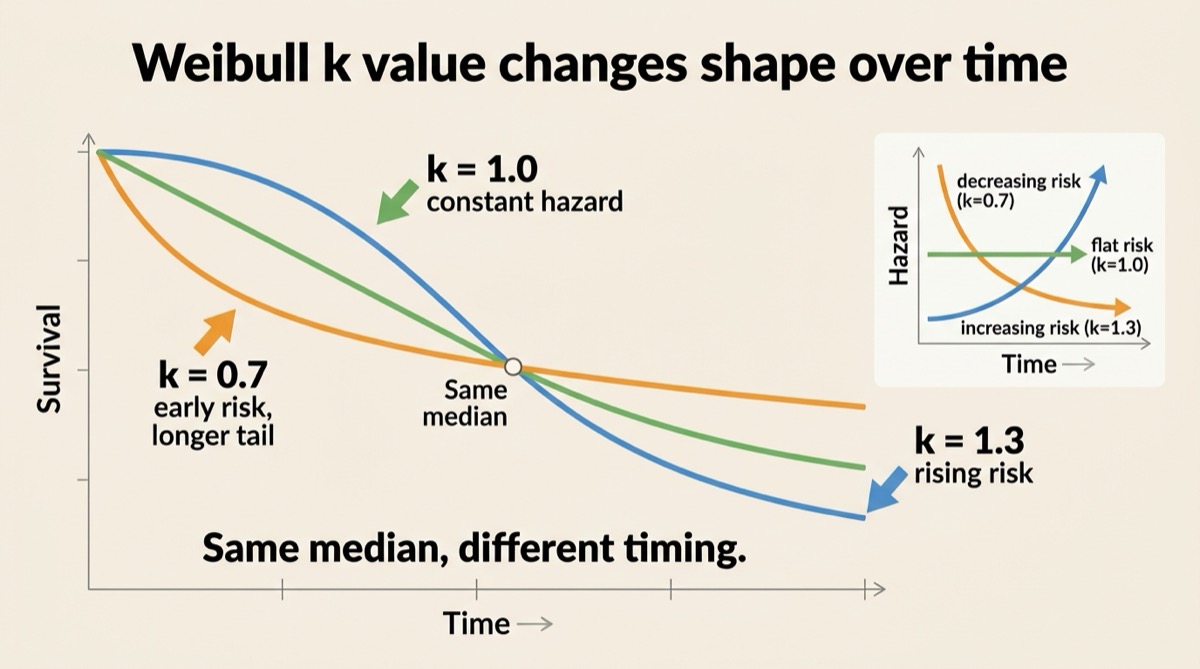
With the same median, k=0.7 front-loads events: the model expects more early deaths among vulnerable patients, then a slower late pace among survivors. That can make 60 events arrive earlier while making the jump from 72 to 78 slower.
In the app, this matters because public anchors are calendar counts. A constant-hazard BAT median and a declining-hazard BAT median can imply different late event pace, even if both quote the same median OS.
Changing k is therefore not cosmetic. It changes whether an assumption fits early and late anchors simultaneously. model idea
Same median, different event calendar: the image illustrates the same point as the slider: lower Weibull k can front-load events and leave a longer tail, while higher k delays early events and rises later. It is a shape intuition, not patient-level REGAL data.
3 Mixture Cure: Plateau vs Long Tail
Math lesson A curve with two groups
A mixture cure model says the population is a blend: some fraction follows a durable plateau, while the rest follow an ordinary declining survival curve.
S(t)=c+(1-c)S_uncured(t)
Here c is the plateau/cure fraction. It does not prove literal biological cure. It is a mathematical way to represent a curve that stops falling quickly and levels off.
A long-tailed non-cure curve can look similar for a while. That creates an identifiability problem: different stories can make nearly the same observed curve over limited follow-up.
REGAL application Why plateau assumptions are powerful
The inverse mode can ask: if GPS has a selected plateau fraction, what BAT median and GPS uncured mOS would make pooled deaths hit the public anchors?
That is useful for sensitivity analysis, but it assigns the durable tail to GPS by assumption. A favorable BAT tail, delayed GPS separation, censoring, or enrollment mix can mimic parts of the same pooled pattern.
This is the core non-identifiability warning: the anchors can support many worlds, including bullish and less bullish ones, until the arm-level split is known.
Identifiability problem: with limited blinded follow-up, a true plateau and a very long tail can be hard to separate. The app makes that assumption visible instead of hiding it inside a single point HR.
4 Enrollment Convolution: Calendar Events Are Integrated Over Entry Times
Math lesson People do not all start on day one
In a trial, patients enroll over months or years. A patient enrolled early has long follow-up by a calendar date; a patient enrolled late has short follow-up.
E[D(T)] = sum over patients [1-S(T-entry_i)]
If enrollment is continuous, that sum becomes an integral over enrollment times. This is convolution: combine the entry-time distribution with the survival curve to get expected calendar events.
REGAL application Why m46, m58, m63 are calendar anchors
REGAL's public event anchors are calendar milestones from trial start, not "everyone has 46 months of follow-up." The app therefore weights patients by when they entered.
Late enrollment can slow event accrual because some patients have not had much time at risk. Conversely, early-enrolled high-risk patients can drive early event counts.
This is why the model has event-timeline checks instead of only fitting a single median. The anchor math asks whether the whole enrolled trial would have produced 60, 72, and 78 pooled events at those calendar times.
Convolution intuition: the app combines the enrollment curve with arm survival curves. Event anchors are generated by all those staggered follow-up clocks added together.
5 Pooled Blinded Anchors and the Inverse Solve
Math lesson Average constraints do not identify components
If you know the average of two numbers is 10, the pair could be 10 and 10, 5 and 15, or 2 and 18. Survival arms work the same way, only with curves instead of single numbers.
pooled survival roughly = 0.5*S_GPS(t)+0.5*S_BAT(t)
Inverse solving means fixing some outputs and solving backward for inputs. It is useful, but it needs assumptions because the same output can come from many input combinations.
REGAL application 60/72/78 constrain the average, not each arm
The public anchors say pooled deaths reached about 60, 72, and 78. They do not say how many were on GPS or BAT. public anchor
In inverse mode, the app takes anchors plus a structural GPS cure assumption and solves for compatible BAT median and GPS uncured mOS. This is a "what worlds fit?" tool, not an arm-split detector.
That is why many worlds can fit the same pooled data: GPS benefit with ordinary BAT, smaller GPS benefit with unusually durable BAT, delayed separation, different Weibull shapes, or censoring/enrollment differences.
World A: strong GPS tail + standard BAT can fit the anchors.
World B: moderate GPS effect + favorable BAT tail can also fit.
World C: near-null arm split is harder to square with some priors, but pooled data alone still cannot mathematically reveal the split.
Public anchors, hidden split: 60/72/78 are real pooled milestones, but the arm-level GPS vs BAT split is not public. The figure shows why inverse solving needs assumptions and why unblinding, not the pooled curve alone, resolves the competing worlds.
Lesson checkpoint: inverse solve is like reconstructing ingredients from the taste of a soup. It narrows recipes that fit the taste, but it cannot prove which ingredient caused it unless you add assumptions.
6 Log-Rank Test, Cox Framing, HR, Z, and FH Sensitivity
Math lesson Observed vs expected events
At each event time, the log-rank test asks: if both arms had equal survival, how many events would we expect in each arm given how many people were still at risk?
E_GPS = d * n_GPS / (n_GPS+n_BAT) U = sum(O_GPS-E_GPS) Z = U / sqrt(V)
U is the scoreboard. V is the variance of that scoreboard under no difference. Z is evidence strength in standard-error units.
Hazard ratio and Z are related but not identical. HR estimates effect size; Z measures how statistically surprising the observed imbalance is.
REGAL application Primary framing and optional FH toggle
The REGAL design paper frames the primary analysis as a stratified Cox model at the 80-event final analysis, with HR < 0.636 as the proportional-hazards design reference. public anchor
The app approximates an unstratified log-rank score from modeled marginal curves. The optional Fleming-Harrington late-weighted toggle gives later event times more influence and is a sensitivity for delayed effects; it is not presented as the confirmed primary SAP weighting.
REGAL's real analysis factors include poor-vs-other cytogenetics plus CR1 duration, response status and MRD. Poor cytogenetics is not equivalent to ELN adverse. Because joint subgroup allocations and effects are unavailable, the app neither substitutes ELN labels nor applies an unsupported scalar efficiency adjustment.
Observed vs expected, one event time
Arm
At risk
Observed deaths
Expected if no effect
GPS
40
0
0.5
BAT
40
1
0.5
A single row barely matters. The log-rank statistic adds this balance check across all event times.
The log-rank test is a standardized balance scale. HR is the estimated relative hazard; Z is how far the observed scale tips after accounting for variance.
7 O'Brien-Fleming Boundary and Conditional Power
Math lesson Interim looks spend alpha carefully
A trial that peeks early needs stricter early evidence, otherwise repeated looks inflate false-positive risk. O'Brien-Fleming style boundaries make early stopping hard and final stopping closer to the usual threshold.
interim: higher Z bar final: lower Z bar conditional power = chance of final success given what is known now
Not stopping early does not mean "no effect." It usually means the interim evidence did not cross the very high early efficacy line, or the review continued for other design reasons.
REGAL application What continuation at 60 does and does not prove
REGAL had an interim at 60 events and continued. Under the public design framing, that makes extreme early-win stories less likely, because a very large early separation might have crossed the OBF efficacy boundary.
But continuation does not prove final failure, final success, or a particular HR. It only adds a constraint to the space of compatible worlds.
The app's binding-interim toggle soft-conditions Monte Carlo on continuation. That changes posterior weight and conditional power; it does not reveal the hidden IDMC data.
OBF boundaries help control false positives across multiple looks. The REGAL continuation is evidence about what did not happen at interim; it is not a final readout.
8 Monte Carlo: Forward, Inverse, and Likelihood Weighting
Math lesson Drawing many possible worlds
Monte Carlo means repeatedly sampling uncertain inputs, calculating outputs, and studying the distribution. It turns "what if this assumption is wrong?" into a visible range.
weight(draw) higher if draw fits observed anchors
Likelihood weighting does not make a draw true. It gives more influence to simulated worlds whose event increments look more like the public data.
REGAL application Sensitivity analysis, not prophecy
Forward MC: draw medians, shape, plateau, delay, censoring, and enrollment assumptions first; then ask which draws fit public anchors and win.
Inverse MC: start from anchors and a structural assumption such as GPS cure fraction; solve for compatible hidden medians and HRs.
Both are useful stress tests. Neither sees arm-level events, future adjudication, true censoring, protocol deviations, or regulatory interpretation.
A Monte Carlo cloud is a sensitivity map. The histogram is a weighted summary of assumptions that fit the anchors better or worse.
9 HR Approximations, Khela-Style Scalar HR, and Stratification Efficiency
Math lesson Effect size depends on the model
A Cox/log-rank HR is an event-time weighted comparison of hazards. A parametric HR from exponential or Weibull curves is a model-implied ratio. A Pike/log-rank HR approximation uses observed-vs-expected event arithmetic.
Pike-style HR approx = (O/E)_GPS / (O/E)_BAT
These can be close under proportional hazards. They can diverge when curves cross, effects are delayed, hazards change over time, or one arm has a plateau.
REGAL application Why scalar HR differs from sliders
A Khela-style scalar HR simulation can apply one risk multiplier across patients. That is clean and fast, but it compresses curve shape into one number.
The SLS-Model sliders can separately change GPS cure fraction, uncured median, delay, BAT median, BAT Weibull k, and long-tail behavior. Those are richer assumptions, so the final Pike/log-rank HR approximation may not match a single scalar HR setup.
The app first mixes ELN prognostic components into one survival curve per arm, then computes the Pike/log-rank approximation from those two marginal risk sets. ELN mix can affect HR only through the resulting marginal curves, not by changing the test's strata.
Lesson checkpoint: HR is not a physical constant. It is a summary of survival differences under a testing framework. When hazards are non-proportional, always look at the curves and event timing, not just one HR label.
Expected value is a probability-weighted average. A simplified biotech version is: value if successful times probability of success, plus other assets, minus or plus balance-sheet items.
risk-adjusted value = P(success) * success value equity per share = (EV + cash) / diluted shares
Changing either probability or share count can move per-share value a lot. That is sensitivity, not precision.
REGAL application Why P(GPS) is separate from p value
The valuation tab's P(GPS) is a user prior for risk-adjusting commercial value. It is not the trial p value, not FDA approval probability from a regulator, and not automatically the Monte Carlo P(win).
The model also separates cash and fully diluted shares. A stronger REGAL view can still be offset per share by dilution, while cash can support runway and add to equity value.
The right way to use this section is to stress-test: change P(success), peak sales, multiples, cash, and diluted shares, then see which assumptions dominate the outcome.
This tab explains the biology behind SELLAS' two drug candidates from the target up: what the target molecule does, then how the drug is designed to act on it. Visuals are hand-built inline SVG or selected conceptual images, labeled and kept on the same color tokens as the rest of the app.
Every mechanistic claim links a primary source (peer-reviewed paper, ClinicalTrials.gov record, or company filing). Where the biology is textbook-established we say so; where a step is the drug's intended mechanism rather than a proven clinical result, we flag it; and clinical numbers that are single-arm or still blinded are flagged as company-reported.
Evidence labels distinguish established biology, computational prediction, mechanistic rationale, small clinical studies, REGAL-unproven hypotheses, class risk, and claims not directly tested for GPS.
Overview Two shots on goal, two different mechanisms
SELLAS is developing two mechanistically unrelated cancer drugs, both aimed at acute myeloid leukemia (AML) and related myeloid cancers. One is an immunotherapy that trains the patient's T cells against a leukemia antigen; the other is a targeted small molecule that shuts off a survival gene program inside the cancer cell.
GPS (galinpepimut-S) — immunotherapy
A WT1-directed peptide vaccine designed to teach CD4⁺ and CD8⁺ T cells to recognize cells that overexpress the WT1 protein — used as remission maintenance. Established biologyMechanistic rationale
SLS-009 (tambiciclib) — targeted small molecule
A selective inhibitor of the kinase CDK9. Blocking CDK9 collapses the short-lived survival transcripts MCL-1 and MYC, pushing leukemic blasts into apoptosis. Established biologyMechanistic rationale
Honest framing: these are two independent programs, not a single combination product. There is no human trial combining GPS + SLS-009 — the "platform" is a two-asset pipeline, discussed in the last section. The REGAL Phase 3 (GPS) remains blinded pending its 80-event final analysis, and the SLS-009 data are from an early single-arm study. REGAL hypothesis / Phase 3 unprovenSmall clinical studies
How to read these claims
Mechanism is not clinical proof. A claim can be solid immunology, a computationally plausible peptide-HLA fit, or a small-study signal and still not prove that GPS improves survival. REGAL survival benefit is unproven until unblinding.
Established biologyComputational predictionMechanistic rationaleSmall clinical studiesREGAL hypothesis / Phase 3 unprovenClass risk / failed elsewhereNot directly tested for GPS
Target 1 WT1 — the leukemia antigen GPS goes after
Established biologyMechanistic rationale
WT1 (Wilms' tumor 1) is a zinc-finger transcription factor. It is largely switched off in healthy adult tissue but is overexpressed in the majority of AML and MDS blasts, which makes it a tumor-associated antigen the immune system can, in principle, be pointed at.
In 2009 an NCI pilot project ranked 75 cancer antigens against pre-set criteria (therapeutic function, immunogenicity, specificity, oncogenicity, expression). WT1 ranked #1 — the single highest-priority target antigen for cancer immunotherapy. That ranking is the core rationale for a WT1 vaccine.
Why a transcription factor makes a usable antigen
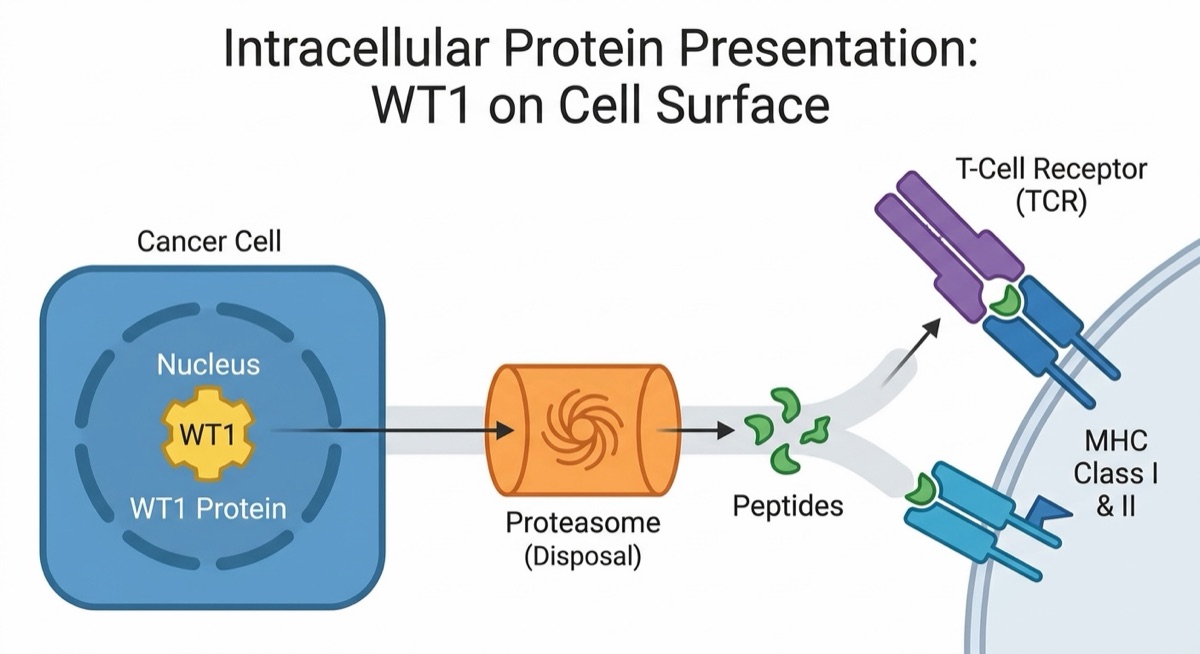
Even though WT1 sits inside the cell (and its nucleus), fragments of it are continuously chopped up and displayed on the cell surface bound to MHC molecules. A T cell that has been trained on those WT1 peptide-MHC complexes can therefore recognize a WT1⁺ blast from the outside — no need for the protein to be on the surface itself. Established biology
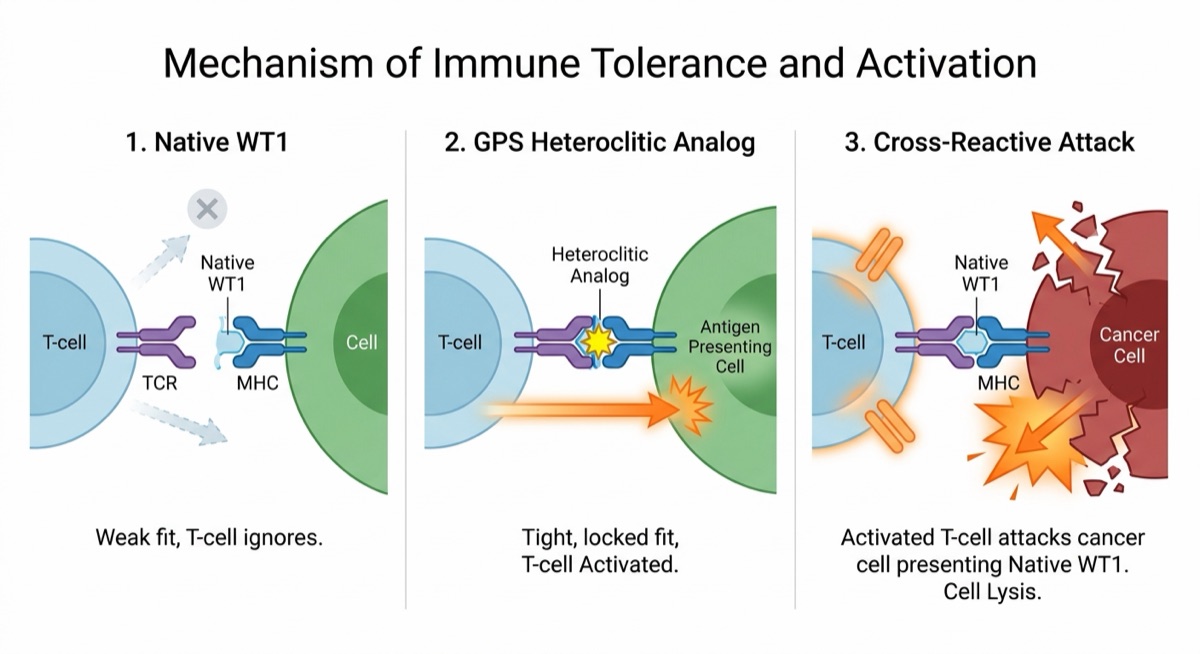
Overexpressed, not neo-antigen: WT1 is a normal self-protein overexpressed by the tumor, so the immune response has to overcome tolerance — the design problem GPS tries to solve (next section). Established biology
Broad applicability: WT1 is expressed across AML, MDS, and several solid tumors, which is why SELLAS frames it as a platform antigen. Established biology
Diagram 0 — WT1 as a usable antigen. WT1 never sits on the cell surface, but proteasomal fragments are loaded onto MHC — the basis for peptide vaccines like GPS. Established biology · Cheever 2009 NCI #1 ranking.
Cheever et al. 2009, Clin Cancer Res — NCI antigen prioritization, WT1 ranked #1: PubMed 19723653
Drug 1 GPS / galinpepimut-S — a WT1 peptide vaccine
Established biologyMechanistic rationaleSmall clinical studiesREGAL hypothesis / Phase 3 unproven
GPS is a mixture of four WT1-derived peptides: two are heteroclitic single-amino-acid variants meant to improve immune teaching, and two are longer native WT1 peptides. The design aims to create CD8⁺ killer and CD4⁺ helper responses across more HLA/MHC display contexts, then use those trained T cells to watch for WT1⁺ residual leukemia. Established biologyMechanistic rationale
GPS mechanism in plain English
Think of each cell as putting tiny protein snippets in a glass display case. The display case is called HLA in people, or MHC in broader biology. T cells do not see the whole WT1 protein; they see a WT1 peptide + HLA display. GPS tries to make that display easier to teach and remember — a coherent mechanism, not proof that REGAL improves survival. Mechanistic rationaleREGAL hypothesis / Phase 3 unproven
Inside-out WT1 target system
Established biologyMechanistic rationale
WT1 is an intracellular transcription factor, but cells continuously chop internal proteins into peptides and display them on HLA/MHC. That turns an inside-the-cell target into something T cells can inspect from the outside.
Conceptual schematic: intracellular WT1 can become peptide-HLA/MHC surface display for TCR inspection. This supports target visibility, not clinical efficacy proof.
WT1 is an overexpressed self-antigen, so tolerance is the design problem. GPS uses two altered WT1 peptides to strengthen immune teaching while aiming cross-recognition back at native WT1 on cancer cells.
Conceptual heteroclitic model: an altered WT1 peptide may strengthen immune teaching while aiming cross-recognition back at native WT1.
CD8 killers plus CD4 help
Established biologyMechanistic rationaleREGAL hypothesis / Phase 3 unproven
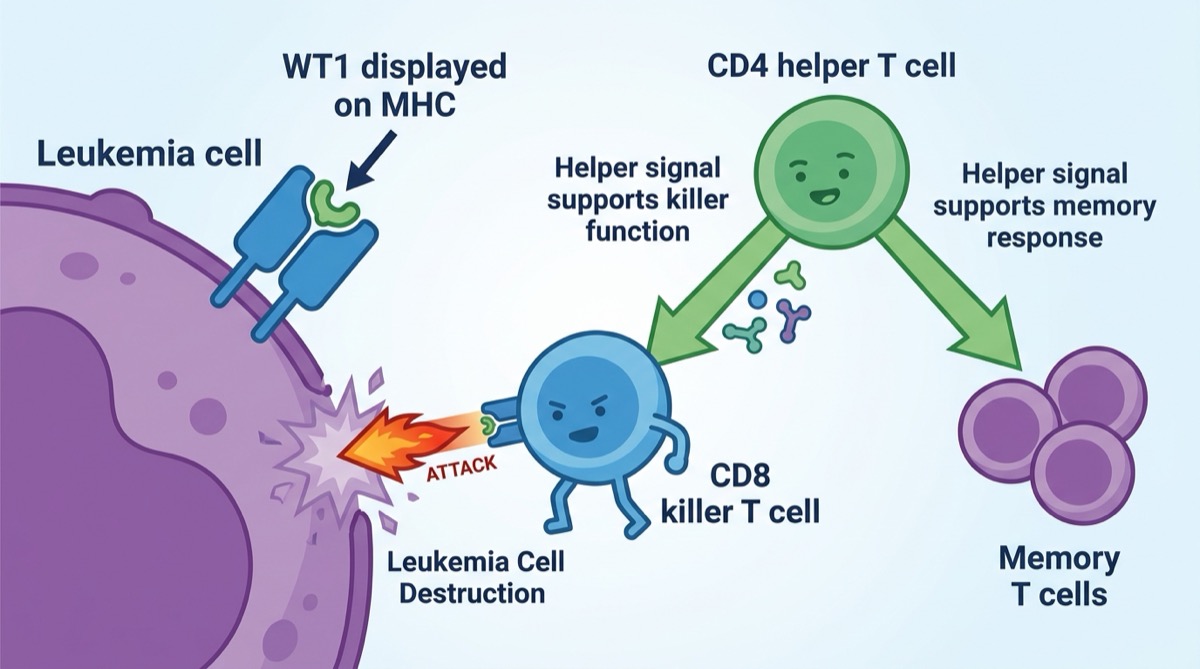
GPS combines a short CD8-oriented WT1 epitope with longer CD4-helper peptides. The immune concept is established: killer cells execute, while helper signals can support stronger and more durable responses.
Conceptual T-cell role map: CD8 cells execute killing after recognizing peptide-MHC, while CD4 help can support cytotoxic function and memory. It illustrates intended immune biology, not REGAL efficacy.
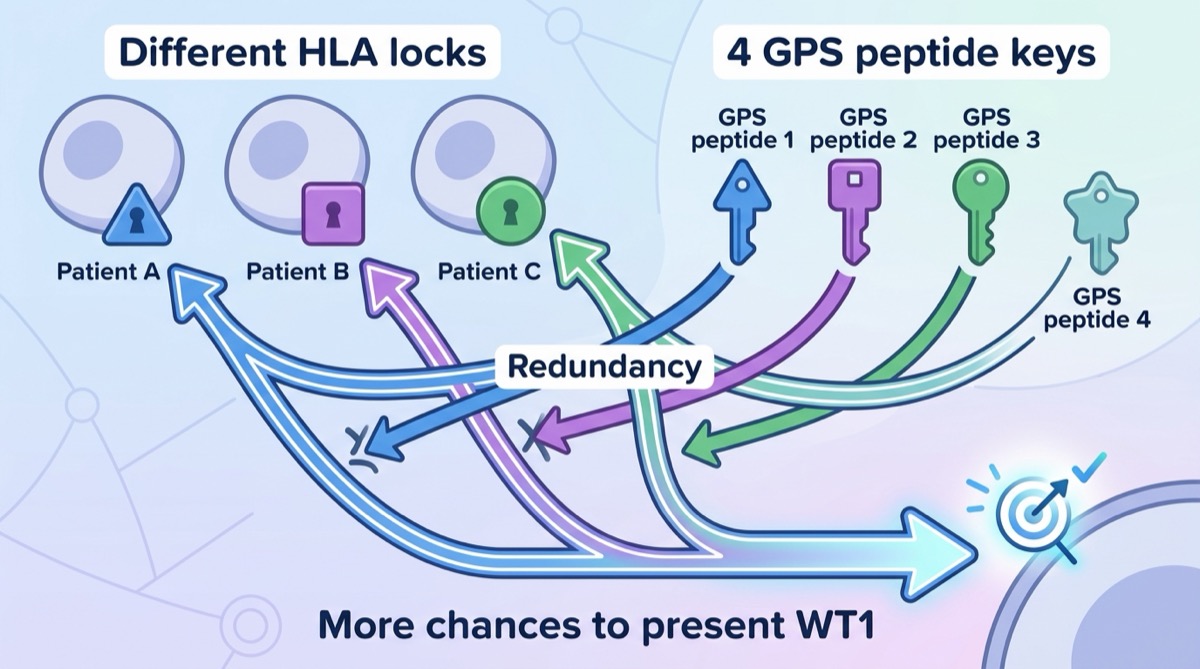
Four keys, many HLA locks
Computational predictionMechanistic rationaleNot directly tested for GPS
People inherit different HLA "locks." A four-peptide design across class I and class II creates more chances for at least one useful WT1 display, but it does not predict any individual patient's response.
Conceptual redundancy model: four WT1-derived peptides can increase presentation opportunities across HLA/MHC contexts. This is schematic coverage logic, not a patient-level response prediction.
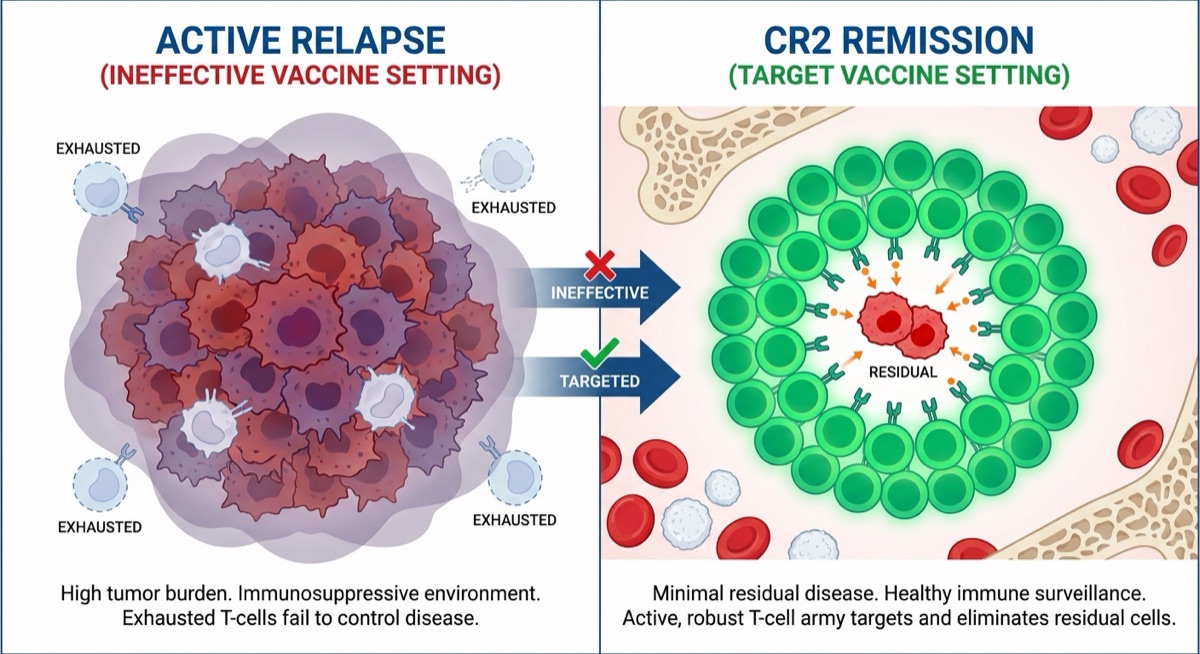
GPS is not a debulking drug for active leukemia. In second remission, bulk disease has already been reduced; the rationale is that lower tumor burden may give immune surveillance better odds against MRD.
Conceptual MRD terrain: lower burden in CR2 may be more favorable for immune surveillance than active relapse; it does not prove GPS clears residual disease in patients.
Delivery depot and APC alarm
Established biologyMechanistic rationale
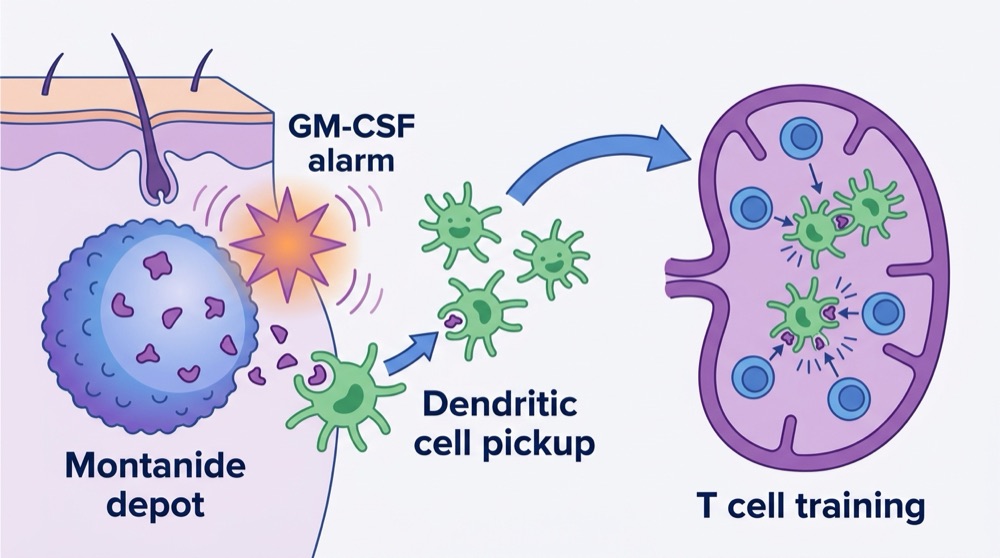
Short peptides can clear quickly. GPS uses Montanide ISA 51 as a depot and GM-CSF pre-dosing to recruit and activate antigen-presenting cells before peptide presentation.
Conceptual delivery schematic: Montanide depot and GM-CSF can support antigen-presenting cell recruitment and peptide presentation; this is mechanism rationale, not clinical efficacy proof.
What MHCflurry and MixMHC2pred add
Computational predictionMechanistic rationaleNot directly tested for GPS
MHCflurry and MixMHC2pred are open computational tools that estimate how well peptide snippets fit common HLA molecules. They are useful for asking, "Is this peptide display biologically plausible?" They are not patient immune assays.
Claim discipline: example computational screens, including user-run MHCflurry/MixMHC2pred runs, can corroborate HLA-presentation plausibility. Unless independently audited here, exact binding-affinity counts should be treated as Computational prediction, not a canonical clinical fact or proof that GPS works in patients.
What this can support
WT1 is a rational antigen; GPS has a biologically coherent CD4+CD8, multi-epitope design; prediction tools can make peptide-HLA presentation more plausible.
What this does not prove
It does not prove a patient will mount T cells, that those T cells kill enough leukemia, or that REGAL improves survival. That requires immune assays and unblinded clinical outcomes.
Mixed-responder sensitivity: Primary sources support broad HLA coverage and heterogeneous immune responses, not a proven uniform cure fraction. HLA-specific REGAL OS is undisclosed, so community HLA decomposition remains a hypothesis until unblinding. REGAL hypothesis / Phase 3 unprovenNot directly tested for GPS
Peptide-vaccine class risk: cancer peptide vaccines have a long history of mechanistic promise with mixed or failed clinical translation across settings. That should temper claims, but failures elsewhere are not direct evidence against this specific WT1 / CR2-maintenance / Montanide + GM-CSF GPS trial. Class risk / failed elsewhereNot directly tested for GPS
Diagram 2 — GPS vaccine flow. Peptides + Montanide + GM-CSF activate an APC, which primes CD4⁺ help and CD8⁺ CTLs; the CTLs lyse WT1⁺ minimal-residual-disease blasts. This is why GPS is positioned in the maintenance / second-complete-remission (CR2) setting — clearing residual cells to delay relapse, not debulking active disease. Mechanistic rationaleREGAL hypothesis / Phase 3 unproven
Honesty flag: immunogenicity (T-cell responses to WT1) is documented in small GPS studies, but the pivotal REGAL Phase 3 (NCT04229979) overall-survival readout is still blinded — the final analysis triggers at 80 events (78 reported as of the May 2026 update). Whether the immune mechanism translates into a survival benefit is the open question, and any REGAL survival-benefit claim is unproven until unblinding. Small clinical studiesREGAL hypothesis / Phase 3 unproven
Kurosawa et al. 2010, Haematologica — AML survival after first relapse (context for the maintenance setting): haematologica.org/article/view/5781
Target 2 CDK9 / P-TEFb — the transcription switch SLS-009 flips off
CDK9 is the catalytic subunit of P-TEFb (positive transcription elongation factor b; CDK9 paired with cyclin T). Its job is to phosphorylate serine-2 (Ser2) of the RNA polymerase II C-terminal domain (CTD), which releases paused polymerase into productive transcriptional elongation. Established
Why cancer cares: the genes most dependent on this elongation step are ones with short-lived mRNAs and proteins — above all MCL-1 (an anti-apoptotic BCL-2-family protein) and MYC. Because MCL-1 protein turns over in roughly an hour, its level tracks ongoing transcription almost in real time. Shut off CDK9 and MCL-1 falls fast, removing a key brake on apoptosis. Established
Diagram 3 — CDK9/P-TEFb axis. Top: CDK9 phosphorylates Pol II CTD Ser2, driving elongation of short-lived MCL-1/MYC transcripts that keep the blast alive. Bottom: SLS-009 blocks CDK9, Ser2 phosphorylation stops, the labile MCL-1 protein falls within hours, and the cell dies. Established mechanism; the CDK9→MCL-1 dependency is the drug's rationale. Theoretical MOA
Anshabo et al. 2021 — CDK9: a comprehensive review (P-TEFb, CTD Ser2, MCL-1/MYC): PMC8143439
Fu et al. 2021 — CDK9 keeps RNA polymerase II on track: PMC8257543
Bewersdorf & Zeidan 2019 — transcriptional silencing of MCL-1 via CDK inhibition in AML: Front. Oncol.
Drug 2 SLS-009 / tambiciclib — a selective CDK9 inhibitor
SLS-009 (tambiciclib; formerly GFH009) is a highly selective, potent CDK9 inhibitor. By blocking CDK9 it suppresses transcription of MCL-1 and MYC, tipping leukemic blasts toward apoptosis (Diagram 3). SELLAS positions it as a differentiated CDK9 inhibitor with improved selectivity/toxicity versus earlier, non-selective compounds. EstablishedCompany-reported
Why it pairs with azacitidine + venetoclax
Azacitidine + venetoclax (AZA/VEN) is the standard of care for older/unfit newly-diagnosed AML. Venetoclax inhibits BCL-2, but leukemic cells commonly escape by leaning on MCL-1 — a different anti-apoptotic protein venetoclax does not touch. Upregulated MCL-1 is a well-documented driver of venetoclax resistance. Because SLS-009 pulls MCL-1 down, adding it to AZA/VEN is a dual BCL-2 + MCL-1 blockade: close both apoptosis escape routes at once. EstablishedTheoretical MOA
Diagram 4 — dual apoptosis blockade. Venetoclax neutralizes BCL-2; SLS-009 (via CDK9 inhibition) strips away MCL-1. With both anti-apoptotic guards gone, pro-apoptotic BAX/BAK drive mitochondrial outer-membrane permeabilization (MOMP) and the blast dies. This is the rationale for adding SLS-009 to AZA/VEN, especially after venetoclax failure. Theoretical MOA
ASXL1 / TP53 relevance
In the Phase 2 study (r/r AML with MDS-related changes, after prior venetoclax), responses were enriched in patients with ASXL1 mutations — a subgroup with historically poor prognosis — and preclinical work shows activity in ASXL1-mutated and TP53-knockout AML lines. SELLAS reports the combination met its primary endpoints in that r/r setting and is moving toward a frontline study. Company-reportedTheoretical MOA
Honesty flag: the SLS-009 efficacy data are from an early, single-arm Phase 2 (no randomized control); response rates and the ASXL1 signal are promising but not yet confirmed against a comparator. Frontline benefit is a hypothesis a randomized trial would have to test. Company-reported / single-arm
Related catalyst (not modeled here): GenFleet runs a separate Phase Ib/II monotherapy trial of GFH009 (same molecule) in r/r PTCL (NCT05934513) — see Tab 2 · Catalysts for timing and scope. PTCL ORR read-through ≠ AML valuation inputs. model
Platform fit Where each drug acts — and what is NOT proven
The two programs are mechanistically independent and act at different points in the AML disease course. GPS is an antigen-directed immunotherapy best suited to low-disease-burden maintenance; SLS-009 is a cell-intrinsic apoptosis primer suited to active or resistant disease alongside AZA/VEN.
Diagram 5 — disease-course fit. SLS-009 targets active/resistant disease with AZA/VEN (studied in relapsed/refractory; frontline planned); GPS targets minimal residual disease in second remission (REGAL). Frontline SLS-009 and the entire GPS→SLS-009 sequencing idea are strategy, not trial-proven. Mechanistic rationaleNot directly tested for GPS
GPS — immune / maintenance
Antigen-directed, rationally positioned against low-burden residual disease as CR2 maintenance to delay relapse. Mechanistic rationaleREGAL hypothesis / Phase 3 unproven
SLS-009 — targeted / active disease
Cell-intrinsic apoptosis primer; restores/deepens response to AZA/VEN by removing the MCL-1 escape. Single-arm Phase 2
Combined platform
Shared WT1/AML focus and a two-asset story — but no human trial combines GPS + SLS-009.Not directly tested for GPS
Bottom line — what is and isn't established: The biology of both targets (WT1 as an antigen; CDK9→MCL-1/MYC) is well established. The drug mechanisms (GPS priming WT1-specific T cells; SLS-009 collapsing MCL-1 to overcome venetoclax resistance) are sound mechanistic rationales with supporting data. What remains unproven: GPS's survival benefit (REGAL blinded, final at 80 events), SLS-009's efficacy versus a randomized control (single-arm), and any GPS + SLS-009 combination (does not exist in the clinic). Established biologyMechanistic rationaleREGAL hypothesis / Phase 3 unprovenNot directly tested for GPS